

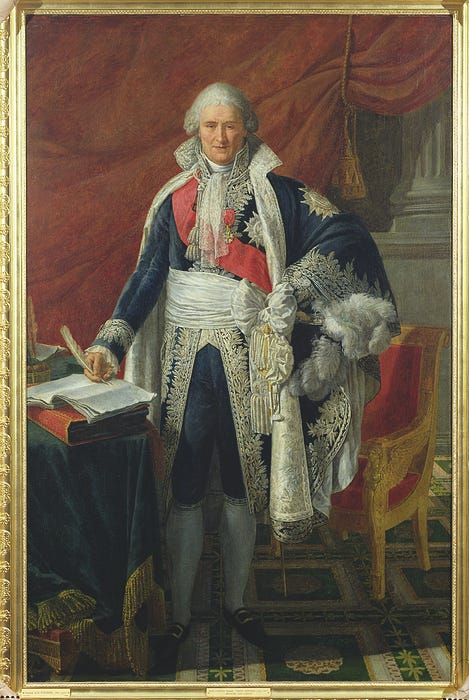
Portrait of Jean-Étienne-Marie Portalis by Pierre-Claude Gautherot, Château de Versailles
Jean-Étienne-Marie Portalis (1746-1807) is best known as the principal drafter of one of the greatest legal achievements in the history of mankind, the French Civil Code of 1804, which has influenced the legal systems of nations around the world, as well as for his memorable “Preliminary Discourse” on the Code, delivered on January 21, 1801. (For an overview of Portalis’ career, see the chapter on him in the excellent volume on “Great Christian Jurists in French History,” edited by Professors Olivier Descamps and Rafael Domingo).
To be sure, there are longstanding debates about the extent to which the Code represented a break with the classical legal tradition, or instead an adaptation of it to new circumstances — questions that Prof. Stéphane Sérafin has addressed elsewhere in our pages. As explained in an instructive paper by a French public law scholar, Prof. Bernard Beignier (which Prof. Thibault Barbieux of the University of Versailles Saint-Quentin was kind enough to send me), Portalis’s own views were rather directly in the tradition stemming from Jean Domat; like his great predecessor, Portalis believed that natural equity founded in reason could and should be consulted when positive law was incomplete or silent, or when the nature of the case at hand required an equitable interpretation of the meaning of a text. But as Beignier also explains, Portalis was in some respects defeated, both by what was left out of the Code and by the subsequent history of its interpretation. Whatever the best understanding of the French Civil Code, however, Portalis’ views are of independent interest for jurists in other legal systems — especially because, as I hope the material below illustrates, Portalis had a gift for expressing those views in a clear, forceful and memorable manner.
In what follows, I have translated1 part of a lesser-known discourse that Portalis presented on December 14, 1801, to one of the lawmaking assemblies of the Consulate, the Legislative Body (Corps législatif), during the consideration of the draft Code. The immediate text under consideration was a provision that eventually became Article 4 of the Preliminary Title of the Code; it states that “The judge who refuses to judge, under the pretext of the silence, the obscurity or the insufficiency of the law, may be prosecuted as guilty of a denial of justice.”2 In defense of this section, Portalis forcefully argues that the positive law is necessarily ambiguous, silent or otherwise indeterminate in some range of “hard cases,” and that in such cases the judge has no choice but to consult — and indeed has a duty to consult — unwritten background principles of natural equity.
Today, in part because of the amnesia that separates many jurists from the tradition, the hard cases thesis tends to be associated with Ronald Dworkin’s “constructivist” version (and other versions are rediscovered, with great excitement, by every new generation of legal academics). But the argument from hard cases is far older than that. A version of it appears in Aquinas’ Treatise on Law, which observes3 that equitable interpretation is sometimes necessary because of the inevitable over-generality or ambiguity of the written law, arising both from limits on the ability of any human legislator to foresee unusual cases, and from the undesirability of trying to capture every possible unusual case in statutory language in any event. The lawmaker should, and inevitably must, focus on providing for central or common cases, while leaving many edge cases and unforeseen situations to the prudent judgment of those who apply the law to particulars.
More precisely, in Portalis’ view, the judge faced with a hard case has no choice but to consult unwritten sources and principles of law unless he is willing, in effect, to abdicate his duty to render judgment in the case at hand. From time to time, positivist judges urge that in cases of unresolvable ambiguity or silence of the positive text, the judge should simply “put [the statute] down and disregard [it],” as Judge Frank Easterbrook once said, or should throw the case back into the lap of the legislator or lawmaker for further direction, as Jeremy Bentham urged. As we will see, Portalis anticipates and rejects both of these approaches as a dereliction of the judge’s duty.
Along the way, he briskly refutes some objections to the traditional approach that are still often heard today, such as the canard that the classical judge displaces the positive law with natural equity. On the contrary, Portalis holds that the judge, rather than displacing the positive law, interprets the meaning of positive law according to natural equity when possible, and consults natural equity to supplement or dis-ambiguate the positive law when necessary. The whole discourse is surprisingly fresh and relevant for current debates — perhaps because similar debates have recurred throughout the history of law, merely reappearing in different guises. At least in law, there is nothing new under the sun.
___________________________________________________________________________
DISCOURSE DELIVERED BY COUNSELOR OF STATE PORTALIS, ONE OF THE SPEAKERS FOR THE GOVERNMENT. (Session of 23 frimarie of the Year 10 — 14 December 1801).4
Article 6.5 The judge who refuses to judge, under the pretext of the silence, the obscurity or the insufficiency of the law, may be prosecuted as guilty of the denial of justice.
Strong arguments have been raised against this article.
One of the speakers has claimed that we have given to the judges a power disavowed by the Constitution. He has told us that, in his view, we lack tribunals of equity who may, depending on the circumstances, soften the application of the laws. There is an equity court in England; at Rome, the praetor was a judge of equity; in France, the king had the right to pardon; and the parlements [i.e. the royal courts of the ancien régime] often departed from the letter of the law. But, among us, the office of the judge is limited to the faithful application of the laws.
All these objections prove nothing against the article; they prove only that the article has not been understood.
The author of the objection would be right, if we were to leave to the judges the freedom to displace positive law with natural equity. Thus, at Rome, the praetor did not apply the law when he believed it to be contrary to natural equity. He had introduced actions based on good faith, in order to evade the laws that had established precise formulas for each action. In England, the court of equity, and in France [under the old regime], the sovereign courts [i.e. parlements], often made rules to modify the laws. But that is not what this is about. Our article addresses only cases in which the law is obscure or insufficient, and those in which there is no law at all. Now, in these various cases, should the judge suspend his office or fulfill it?
When a law is obscure, the duty of the judge is to study it. His further duty is to supplement it, when it is insufficient or when it preserves an absolute silence. If you refuse this power to the judges, all courts are banned. No one ever brings suit in the face of a precise legal text. There is only litigation when there is at least an apparent doubt. If the judges, when the law is not clear and precise, may deny justice, there will be disorder in society; and by what means will you settle the conflicts of men? Will one request a law for the particular case? But the parties would not have contracted in reliance on that law, which did not yet exist; one would fall into all the difficulties of a retroactive effect. However, one cannot leave undecided questions of property and other similar questions. It is therefore necessary that the courts pronounce judgment.
But may the courts do anything but apply an extant law? Read the celebrated author of The Spirit of the Laws [i.e. Montesquieu]; he observes that, in a republic, judgments must only ever be the application of a precise text.
We answer that the author of The Spirit of the Laws spoke of criminal matters. In these matters, one may only pursue crimes that the law has defined, and one may only pursue penalties that the law inflicts.
Thus, according to our article, when the accusation is based on a fact that the law has not held to be a crime, and against which the law will consequently not have inflicted any penalty, the judge will absolve the accused; but he must still render a judgment; he would not be able to suspend his office without exposing himself to the accusation of having denied justice.
In civil matters, one of two things must occur, either ban the power of judging, or leave to the judges a type of latitude when the law is obscure, or when it is silent; because civil matters are immense, and the foresight of the laws is limited. It is impossible to have one law for each particular case. There is no need for a law for rare and extraordinary cases. The excessive multiplicity of laws is a great political vice. Laws should be prepared slowly and with maturity; they must be indicated by experience. If you hasten legislative measures, laws will overwhelm society, instead of regulating it. There were judges before there were laws, and the laws can never reach all the cases that present themselves to the judges. One must therefore leave to the judicial power the authority that derives from the most imperious of all laws, that of necessity.
Any and all errors, em-dashes and overdrawn antitheses are my own, rather than a product of “that hideous strength,” an Artificial “Intelligence.”
Le juge qui refusera de juger, sous prétexte du silence, de l’obscurité ou de l’insuffisance de la loi, pourra être poursuivi comme coupable de déni de justice.
ST I-II, Q. 96, art. 6, Reply obj. 3: “No man is so wise as to be able to take account of every single case; wherefore he is not able sufficiently to express in words all those things that are suitable for the end he has in view. And even if a lawgiver were able to take all the cases into consideration, he ought not to mention them all, in order to avoid confusion: but should frame the law according to that which is of most common occurrence.”
DISCOURS PRONONCÉ PAR LE CONSEILLER D’ÉTAT PORTALIS, L’UN DES ORATEURS DU GOUVERNEMENT. ( Séance du 23 frimaire an X. - 14 décembre 1801. ). The portion of the discourse translated here is pp. 268 et seq. in P. Fenet, RECUEIL COMPLET DES TRAVAUX PREPARATOIRES DU CODE CIVIL, Tome Sixième (Paris 1836). The French text runs as follows:
On a déployé de grandes forces contre cet article.
Un des orateurs a prétendu que nous donnions aux juges un pouvoir désavoué par la Constitution. Je sens, nous a-t-il dit , qu’il nous manque des tribunaux d’équité qui puissent, suivant les circonstances, adoucir les lois. Il y a une cour d’équité en Angleterre; à Rome, le préteur était un juge d’équité; en France, le roi avait le droit de faire grâce; et les parlements s’écartaient souvent de la lettre de la loi. Mais, parmi nous, le ministère du juge est circonscrit dans l’application fidèle des lois.
Toutes ces objections ne prouvent rien contre l’article; elles prouvent seulement que l’article n’a pas été entendu.
L’auteur de l’objection aurait raison, si nous laissions aux juges la liberté de mettre l’équité naturelle à la place de la loi positive. Ainsi, à Rome, le préteur n’appliquait pas la loi, quand il la croyait contraire à l’équité naturelle. Il avait introduit les actions de bonne foi, pour éluder les lois qui avaient établi des formules précises pour chaque action. En Angleterre, la cour d’équité, et en France , les cours souveraines, faisaient souvent des réglements pour modifier les lois. Mais ce n’est pas ce dont il s’agit. Notre article ne dispose que pour les cas où la loi est obscure ou insuffisante , et pour ceux où il n’y a même point de loi. Or, dans ces différens cas, le juge doit-il suspendre son ministère ou le remplir?
Quand une loi est obscure, l’office du juge est de l’étudier. Son office est encore de la suppléer, quand elle est insuffisante ou quand elle garde un silence absolu. Si vous refusez ce pouvoir aux juges, tous les tribunaux sont frappés d’interdiction . Car on ne plaide jamais contre un texte précis de loi. Il n’y a litige que lorsqu’il y a un doute au moins apparent. Si les juges, lorsque la loi n’est pas claire et précise , peuvent dénier la justice, le désordre sera dans la société ; et quel moyen aurez - vous de vider les contes- tations des hommes? Sollicitera - t - on une loi pour le cas particulier? Mais les parties n’auraient point contracté sous la foi de cette loi qui n’existait point encore; elle ne pourra donc les juger. On tomberait dans tous les inconvéniens de l’effet rétroactif. Cependant on ne peut laisser indécises les questions de propriété et autres questions semblables. Il faut donc que les tribunaux prononcent.
Mais les tribunaux peuvent - ils faire autre chose qu’appliquer une loi existante ? Lisez le célèbre auteur de l’Esprit des Lois: il observe que, dans une république, les jugements ne doivent jamais être que l’application d’un texte précis.
Nous répondrons que l’auteur de l’Esprit des Lois a parlé pour les matières criminelles . Dans ces matières, on ne peut poursuivre que les crimes que la loi a définis , et on ne peut appliquer que les peines que la loi inflige.
Ainsi, d’après notre article, quand l’accusation portera sur un fait que la loi n’aura pas réputé crime, et contre lequel elle n’aura conséquemment infligé aucune peine, le juge absoudra l’accusé; mais il faudra toujours qu’il rende un jugement: il ne pourrait suspendre son ministère sans s’exposer au reproche d’un déni de justice.
Dans les matières civiles, il faut de deux choses l’une, ou interdire la puissance de juger, ou laisser une sorte de latitude aux juges quand la loi est obscure, ou quand elle se tait; car les matières civiles sont immenses, et la prévoyance des lois est limitée. Il est impossible d’avoir une loi pour chaque cas particulier. Il ne faut point de loi pour les cas rares et extraordinaires. La trop grande multiplicité des lois est un grand vice politique. Les lois doivent être préparées lentement et avec maturité : il faut qu’elles soient indiquées par l’expérience. Si vous précipitez les mesures législatives, les lois accableront la société, au lieu de la régler. Il y avait des juges avant qu’il y eût des lois, et jamais les lois ne pourront atteindre tous les cas qui se présentent aux juges. Il faut donc laisser au pouvoir judiciaire les attributions qui dérivent de la plus impérieuse de toutes les lois, de celle de la nécessité.
At the time of the discourse, the draft article was so numbered, but the sequence was eventually changed during the enactment process.
This is fascinating. Thank you, Prof. V.
Many years ago, I had started working on a kernel of a (legal writing) idea on the subject of judicial review, after reading Dworkin's "Law's Empire" not too long after law school. I remember my working title was "A Preference for Liberty," but recall very little of the substantive content. This runs somewhat alongside it, I would say, and it's nice to know that my uneducated blobs of thought at least manage to have a kernel in common with some great legal minds of the past.
Thanks as always for your illuminating articles, Prof. I have nothing to add except to note Footnote 1 not only adds to the strength of your thesis, it also demonstrates how in real situations in real life, judges must face the difficult outliers statutes cannot cover: "Any and all errors, em-dashes and overdrawn antitheses are my own, rather than a product of 'that hideous strength', an ‘Artificial “Intelligence’.” Judges need to face the difficult outliers. If they don’t, who will?
I also note the distinction Portalis' made of civil matters v. criminal matters.