

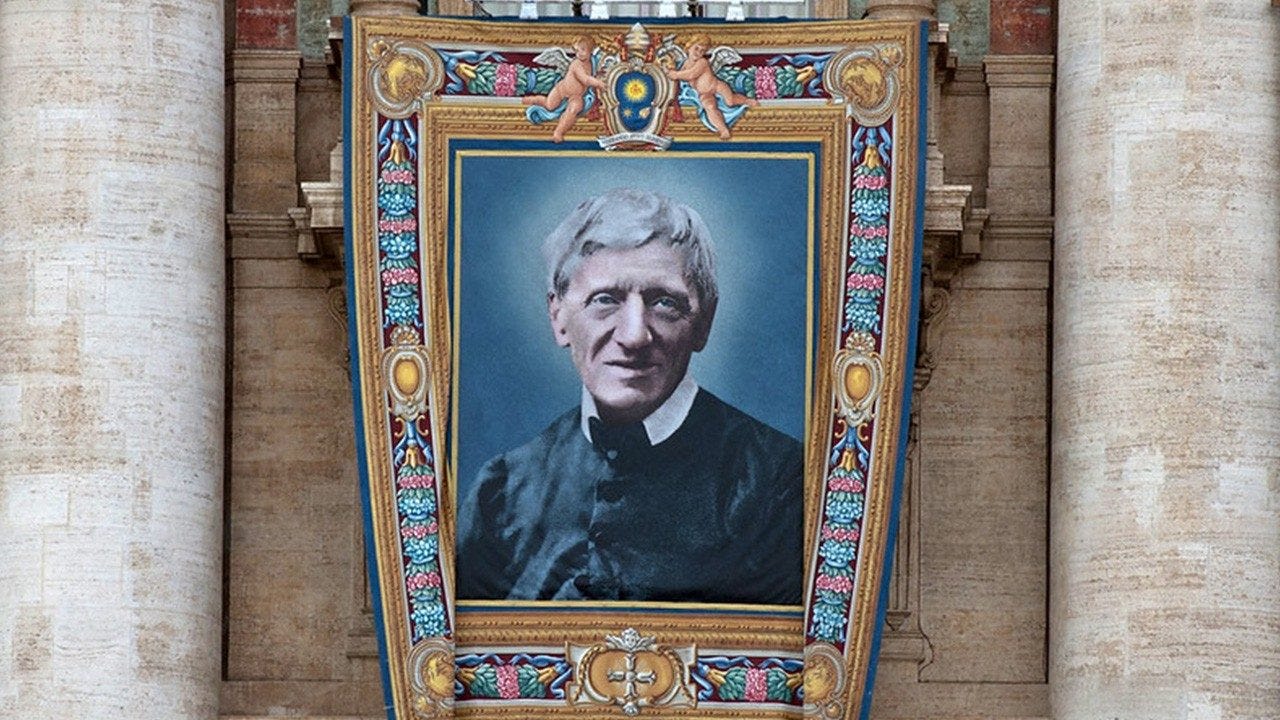
In honor of the wonderful announcement that St. John Henry Newman will be recognized as Doctor of the Church, I thought I’d collect some previous writings on the topic of Newman, liberalism, and the law. Rather than just listing these links, I have integrated them into the text of the following short reflection.
Newman, along with Cardinal Manning, was among other things the most withering critic of liberalism in the Victorian era in Britain. His main target is theological liberalism, which he defines in a note to his autobiography as “false liberty of thought … the mistake of subjecting to human judgment those revealed doctrines which are in their nature beyond and independent of it.” But it is indisputable (although one can, of course, find people disputing it) that for Newman, the critique of theological liberalism implies also a critique of political liberalism. Indeed, Newman’s very point is that these are not separate topics.
Observe the train of thought in Newman’s famous “Biglietto Speech,” on the occasion of being made a cardinal by Leo XIII in 1879. Describing the “great apostasia” that he sees as having overtaken Christian countries in the 19th century, Newman moves by logical steps from the issue of theological liberalism to the question of the constitution of the political order:
To one great mischief I have from the first opposed myself. For thirty, forty, fifty years I have resisted to the best of my powers the spirit of liberalism in religion…. Hitherto the civil Power has been Christian. Even in countries separated from the Church, as in my own, the dictum was in force, when I was young, that: "Christianity was the law of the land". Now, everywhere that goodly framework of society, which is the creation of Christianity, is throwing off Christianity. The dictum to which I have referred, with a hundred others which followed upon it, is gone, or is going everywhere; and, by the end of the century, unless the Almighty interferes, it will be forgotten. Hitherto, it has been considered that religion alone, with its supernatural sanctions, was strong enough to secure submission of the masses of our population to law and order; now the Philosophers and Politicians are bent on satisfying this problem without the aid of Christianity.
Newman’s thought is subtle, however, and there is a sense in which he sees liberalism, although a grave error in itself, as also a felix culpa or happy fault — an error from which Providence brings even greater goods. I discuss Newman, liberalism, and providential history at length in this essay on “Liberalism as a Felix Culpa” — also re-published elsewhere under a different title.
If Newman was a critic of political liberalism, and lamented the loss of a society in which Christianity was the law of the land, this is not at all to say that he thought the civil power should be ruled by the Church in any direct sense. (This is of course a stock confusion among many liberals, who mistakenly equate the ordering of polity to natural and divine law with rule-by-priests or “theocracy” or some such). Part of what it means for Christianity to the law of the land is itself that the temporal power has a legitimate sphere of independence, in which just rule is a matter of prudence and in which many different determinations of the constitutional order are possible, in accord with the history, traditions and spirit of any given people. Surprisingly, in the context of the Crimean War, Newman wrote a series of letters on British constitutionalism (collected under the title “Who’s to Blame?”) that outline a set of principles for the civil order, emphasizing that the operative small-c constitution is rooted in national traditions. I discuss Newman’s views of constitutionalism here (in the context of offering a reading list on Catholic Constitutionalism, including works by De Maistre and Schmitt).
More generally, in a talk for students that was published on Ius et Iustitium, I try to lay out a primer on the classical and Catholic view of constitutionalism, emphasizing — in the spirit of both Newman and Montesquieu — the broad scope for legitimate variation of regime-forms in any given polity.
Lest the reader think that Newman’s thought is only relevant to broad principles of constitutionalism, not to more specific legal problems within our constitutional order, we previously collected a series of posts applying Newman to particular legal topics. A prime example is the analogy between his views of the development of doctrine, on the one hand, and the developing application of enduring legal traditions and principles. The Catholic Bishops’ Conference drew upon this analogy to write an amicus brief in the Rahimi case — a brief that seems to have heavily influenced the Chief Justice’s opinion for the Court. For further explanation and links, here is the collection:
St. John Henry Newman and the Law

The New Digest is a reader-supported publication. To receive new posts and support our work, consider becoming a free or paid subscriber.
Much more will be said, no doubt, on the subject of Newman, liberalism, and the legal order. But this brief treatment is merely intended to underscore the remarkable fact that Leo XIV has made a Doctor of the Church one of the leading critics of liberalism in the English-speaking world. The post-liberal Church, and world, comes ever more clearly into view.
If the constitution was instituted by liberals, and we are entering post-liberalism as a reaction to its excesses, is it unreasonable to think that post-constitutionalism is next? Or is constitutionalism not inherently liberal?
If you have the time, I've heard accusations of the good Doctor laying the ground for legal positivism and would appreciate either being pointed in the direction showing this isn't true to study on my own, or an article I can point to so as to answer such accusations.