


Is St. John Henry Newman’s thought relevant for legal theory? I firmly believe so (and as it turns out, so does the United States Conference of Catholic Bishops, which has written influential amicus briefs drawing on Newman — as explained below). So I thought I’d consolidate in one place my writings on the subject, which turned out to be more extensive than I realized. Some are from the archives of The New Digest, others are from recent work elsewhere, and there is even a podcast appearance for those so inclined. And I added two excellent pieces on related themes from other New Digest authors. A few notes are included with the entries to provide context. Hope you enjoy!
Common Good Constitutionalism (2022)
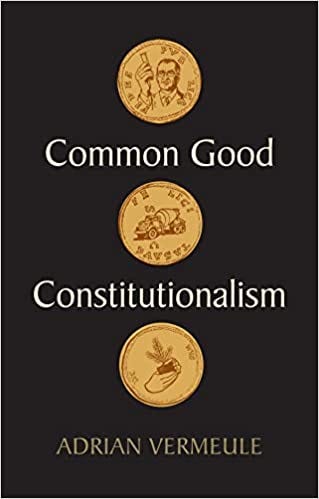
Chapter 4 of the book is an extended treatment of Newman’s theory of “development of doctrine” and its legal applications, which I call “developing constitutionalism.” The chapter also offers a contrast between that approach and progressive constitutionalism. The fundamental purpose of developing constitutionalism is to “preserve the rational principles of the constitutional order as the circumstances of the political, social and economic environment change.” The chapter’s central distinction, between enduring principles and developing applications that preserve what Newman called the “notes” of the underlying principles, is further discussed throughout the works collected here. And see the cover image of the book for an implicitly Newmanesque message:
Runnymede Radio Podcast
In conversation with two excellent Canadian lawyers, Xavier Foccroulle Ménard and Jake McConville, I discussed the development of doctrine and its application to law, legal principles and legal precedent in (even more) depth on the podcast of the Runnymede Society, available here.
Rahimi and the Principled Development of Doctrine
In one of the most methodologically important cases in the end-of term rush at the Supreme Court, U.S. v. Rahimi, the Chief Justice, writing for the Court on a Second Amendment issue, said that “the proper inquiry is not a search for narrow historical analogues to founding-era regulation, but rather an attempt to discern ‘the principles that underpin our regulatory tradition…. Discerning and developing the law in this way is a commonplace task for any lawyer or judge’” (emphasis added). Although the traditional principles of the law endure, their application is not “trapped in amber.” This is unmistakably Newman-esque, making the key distinction between consistent principles and developing applications. The post explains in more detail.
Rahimi as Principled Development of Doctrine

In a surprising turn, the classical legal language of constitutional principles and the development of doctrine is back with a vengeance. In United States v. Rahimi, the Chief Justice, writing for the Court, rejected a Second Amendment challenge to a federal statute that prohibits individuals subject to a domestic violence restraining order from possess…
The Chief Justice and the Catholic Bishops
After publishing the Rahimi post, I belatedly learned (yes, I should have figured this out earlier) that the United States Conference of Catholic Bishops had written an amicus brief in the case which looks to have been highly influential on … someone at 1 First St. NE. Certainly there is substantial commonality between the brief and the Chief Justice’s opinion for the Court. And I was pleased to see that the brief (and opinion) adopted an account of the development of doctrine and its application to law that parallels my own (and, incidentally, one that is inconsistent with the views of a non-lawyer journalist, Matthew Walther, on the same topic, as explained in the post below).
The Chief Justice and the Catholic Bishops

Well, my bad. I wrote a post about how the recent majority opinion in United States v. Rahimi adopted continuity of constitutional “principles” over time as the best approach to the history and tradition of the Second Amendment; adopted a legal analogy to St. John Henry Newman’s idea of the “development of doctrine”; and in general was admirably rooted …
Tradition as a Freestanding Source of Law
Another angle for viewing Newman’s thinking on development of doctrine is the question of tradition as a source of law in its own right — an important theme in the Catholics Bishops’ brief discussed above, and treated at greater length here.
Tradition as a Freestanding Source of Law
It very much looks as though the originalist movement is struggling with basic questions of method. (See the multiple concurrences, mostly solo concurrences, by originalist Justices pondering method in two recent decisions, United States v. Rahimi and
Equity Trapped in Amber
Prof. Anna Conley picks up the Chief Justice’s line about the application of principles not being “trapped in amber,” and spins it out into a fascinating critique of the Court’s recent, narrowly originalist equity jurisprudence. Essential reading not only for the equity lawyers, but for students of the Court’s methodology.
Equity Trapped in Amber

The New Digest is pleased to present this guest post from Dr Anna Conley. Dr. Conley is an Assistant Professor at the Alexander Blewett III School of Law at the University of Montana, and has a background in civil law. The post explains some of her important recent work on the judicial power, equity, and originalism, both in the United States and in com…
What Exactly Is the Common Law?
Prof. Lucas Clover-Alcolea draws expressly on Newman’s development of doctrine to offer an impressive classical-legal account of the nature of the common law and of common-law precedent. Highly recommended!

Common Good Constitutionalism and Constitutional Change
Last but certainly not least, run don’t walk to read The New Digest’s own Prof. Conor Casey apply the classical legal framework to the question of constitutional change over time. Enjoy!
New Paper: Common Good Constitutionalism and Constitutional Change
In case it is of any interest to our subscribers looking for more academic/longform/tedious(!) writing in a classical legal vein, I (Conor) have uploaded a working paper about Common Good Constitutionalism and constitutional change to SSRN. The paper was written for a forthcoming edited volume on Constitutional Change. I was invited to contribute a chap…