
On St. Thomas More

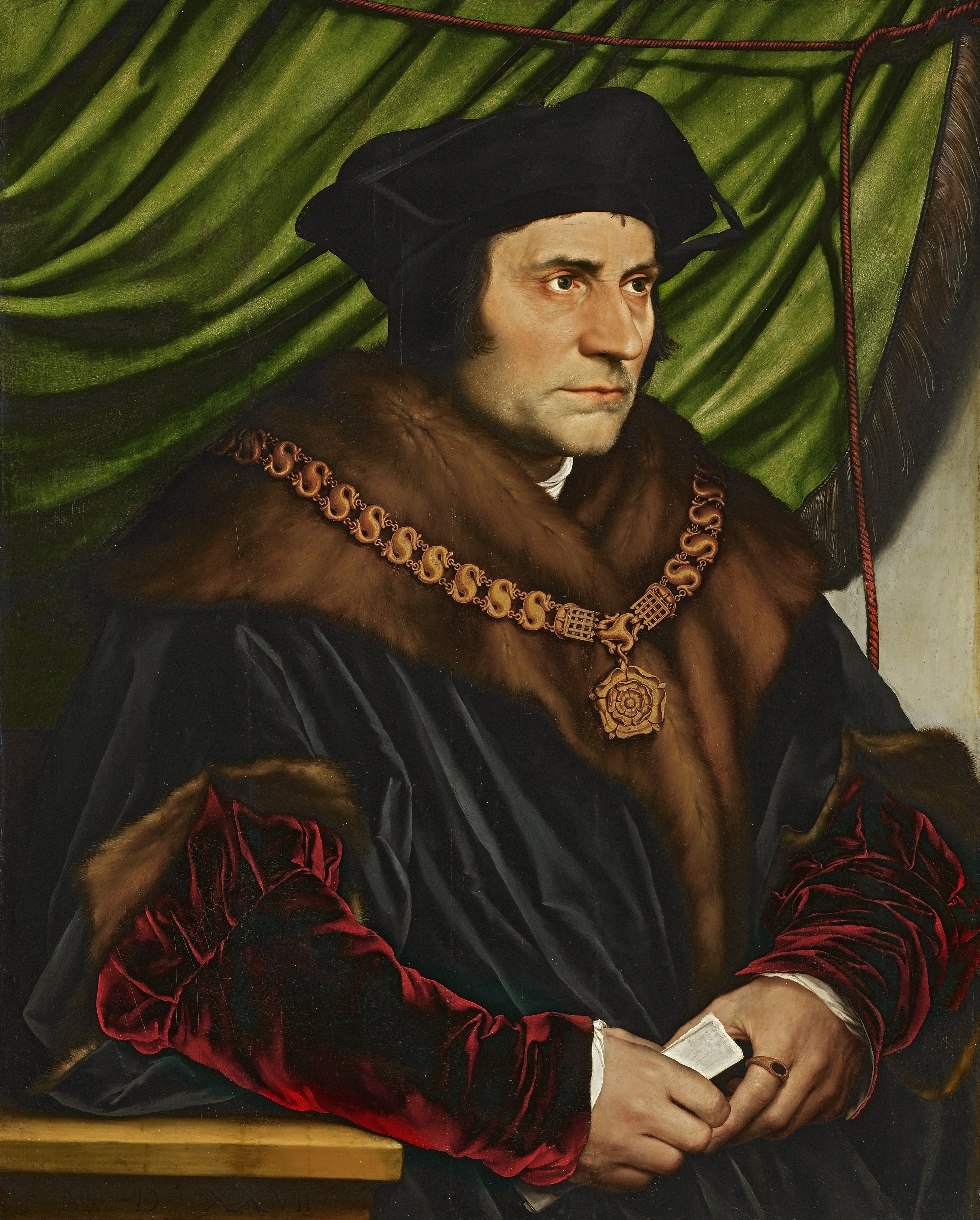
“Give me the grace, Good Lord, to set the world at naught. To the set the mind firmly upon Thee, and not to hang upon the words of men’s mouths.”
—Untitled Prayer, Tower of London, 1534-35, St. Thomas More
Four hundred ninety-one years ago today, July 6, 1535, Thomas More, former Lord Chancellor of England, was beheaded as punishment for treason for refusing to accept King Henry VIII as the supreme head of the Church in England (and, at least equally as much, for refusing to assent to Henry’s adulterous marriage). More was a prolific scholar, Christian humanist, able polemicist, and public figure, well known in the Europe of his time. He was, of course, a classical lawyer, and classically minded. He is my patron Saint, besides being the patron of all lawyers.
For that reason, I wished to write today in his honor. The standard invocation of St. Thomas More in American culture today is the man who died for “freedom of conscience.” He held a conviction so tightly as to what was right, and refused to abandon it, and was killed for it. “Always follow your heart” or something. This narrative fits easily with modern liberal pieties. It is for all material purposes, however, false. So I want to contribute to the much needed recovery of the real Thomas More.
First, I want to part ways with a previous characterization of St. Thomas More that was published here at the New Digest earlier this year. At that time and today, I think this provocative piece was directionally correct in ways, and an admirable effort to put distance between the fictional character of Robert Bolt’s play (and the 1962 Hollywood adaptation of it), and the real Saint. But it was wrong in some ways, some of which are important. For instance, the idea that it is false that More was “Processmaxxing” to avoid death and that to suggest he did such a thing impugns More’s moral character and commitments, is wrong. I suppose it depends what we mean by the neologism in question, but there is simply no doubt that More, the ever skilled lawyer, used every available legal tool at his disposal to do just what natural law would dictate to any person, and what Divine Law made clear: avoid dying if he could, and avoid sinning at all costs. No one with substantial familiarity with primary sources regarding More’s life, trial, and execution could deny it.
But, contrary to what has been suggested, this was not “fear of death,” let alone “sin[ful.” Rather, what is on display was the virtue of prudence. More did not simply “refus[e] the Oath of Sucession outright” in some highly visible act of defiance at the earliest possible moment after its promulgation. He indeed engaged in numerous legal and rhetorical machinations to try to get to the right outcome before engaging in what he understood was a nuclear option of sorts. Why? Because Thomas More had a soul that only Christendom could create. A soul rather alien to modern man. An enormous soul who died, as he is famously reported as saying upon the scaffold, “the King’s good servant, and God’s first.” To his dying moment, Thomas More saw no contradiction in his actions, and understood the real and classical nature of the law (arguing in an oral motion for arrest of judgment before sentence that the Act of Parliament was void because conflicted with Divine Law!). Cf. Summa Theologiae, I-II, Q.96, Art. 4. He loved Henry and he loved God and served them both. Projecting contemporary concerns about “Processmaxxing” is anachronistic, but ultimately just fumbles the historical facts and lessens the brilliance, sagacity, and virtue of a Christian Saint.
Second, with that out of the way, I want to turn to what I think is a more illuminating episode for understanding More the Saint, which, in my view, necessarily defeats any attempt by modern liberals to claim More as one of their own.
Much like St. John Henry Newman centuries later, More wrote brilliantly on matters of “conscience,” and invoked his conscience both publicly and privately as a ground for his refusal to take the Oath of Supremacy. Yet, More (and Newman) had such a particular (and Catholic) sense of what the “conscience” was that could serve as a ground for such actions, and that sense differs so wildly from what people ordinarily mean by “conscience” or “freedom of conscience” today, that I see emphasis of those aspects of More’s writings to be practically useless and at times even affirmatively harmful in popular discourse. I will not, here, write at any length on particular More’s beliefs about freedom of conscience, but rather, demonstrate that what he meant necessarily carried a different meaning than is commonly attributed to him today. Two examples will do:
In June 1529, at the request of the Bishop of London, More published his work now known as A Dialogue Concerning Heresies, aimed at countering the arguments of the Protestants via the classical dialogue framework (a framework More frequently deployed in his writings). Book 4, Chapters 13-15 offer the strongest antidote to the notion that More is liberal or a proto-liberal in any sense. As his chapter head for Chapter 13 states, More “showeth his opinion concerning the burning of heretics, and that it is lawful, necessary, and well done, and showeth also that the clergy do not procure it, but only the good and politic provision of the temporalty.” In no uncertain terms, More believed “That princes be bounden to punish heretics, and that fair handling helpeth little with many of them.” These chapters go on for pages and pages defending More’s position. More vigorously believed that it was right and proper and an affirmative duty of the civil magistrate to punish, appropriately but up to and including by burning alive, heretics, once properly so declared by the Church’s spiritual authority.1 Freedom of conscience?
Relatedly, in Book 3, Chapter 8, More engages a lengthy argument to show “why the New Testament of Tyndale’s translation was burned, and showeth for example certain words evil and of evil purpose, changed.” As More argued, “It is … to me a great marvel that any good Christian man having any drop of wit in his head would anything marvel or complain of the burning of that book if he know the matter…. For so had Tyndale … corrupted and changed it from the good and wholesome doctrine of Christ to the devilish heresies of their own, that it was clean a contrary thing.” More saw in Tyndale’s changing of words like priest, church, and charity to elder, congregation, and love such a tendency for spiritual perniciousness that it easily warranted the torching of the whole book so that the public would not be led into error. And so it should be burned. No marketplace of ideas.2
These are stark facts. Hard facts. Real facts. But they are the real Saint. His Dialogue on these matters are skillfully argued from first principles, Holy Scripture, the Fathers, historical examples, and law. These facts—along with More’s canonization—force Catholics to several choices. One can believe More was wrong in principle (I think the only honest choice for modern liberals). What he did was morally wrong and his Sainthood is perhaps only the by-product of his clear martyrdom for the Catholic faith, despite his wrongful writings and actions. One can believe he was right in principle but misguided in practice at the time. He was, after all, imperfect as we all are, and he would be the first to admit to his sinfulness. One can believe he was right in both principle and practice of the time. He is a Saint. He lived a life of heroic virtue besides his martyrdom, and he was faithful to clear magisterial Catholic teaching, writing not only with the approval of, of at the direct behest of his Bishop. And one can certainly hold the latter, while maintaining that the circumstances of today do not warrant today what were warranted in More’s time. We do not live in such times, and such practices would likely be counter-productive under current conditions and thus ultimately spiritually harmful to many. I’m not adjudicating here today how you ought to feel about More except for this: what one cannot do is claim that More was a believer in modern “freedom of conscience” or approached “liberalism” in any way.
As a final reflection, I’ve appended here in the final footnote the full text of the Homily delivered in 1935 by Pope Pius XI at the canonization of St. Thomas More and St. John Fisher.3
More is, however, not overeager about these things, according to his writings. In his view, for instance, he often sees the use of force by civil magistrates, whether directed at “heretics” or “infidels” (Muslim Turks), as being a kind of act of self-defense, often occasioned by the latter’s’ first invocation of violence. And he is also keen to ensure that judgements of heresy are made carefully, and that punishments are meted out only to those who are obstinate and willful, rather than to those who are simply misguided or mistaken. In those writings, we see what we might understand as the virtue of liberality, without being a “liberal.”
This is all quite apart from More’s personal involvement in the approval and potentially even administration of civil punishments on such matters during his time as a civil magistrate in England.
As Jesus Christ, according to the words of St Paul, is eternal and immutable, “yesterday and today, and the same forever,” so the Church founded by Him is destined never to perish. Generations follow and succeed each other with their perennial vicissitudes. But whereas human institutions give way and disappear before the levelling tide of time, and human sciences, reflecting inconstant light, undergo repeated transformations, the Cross of Christ, reared steadfast above the engulfing billows, never ceases to illumine mankind with the beneficent splendour of Eternal Truth.
From time to time new heresies make their appearance and, under the guise of truth, gain strength and popularity; but the seamless garment of Christ can never be rent in twain. Unbelievers and enemies of the Catholic faith, blinded by presumption, may indeed constantly renew their violent attacks against the Christian name, but in wresting from the bosom of the militant Church those whom they put to death, they become the instruments of their martyrdom and of their heavenly glory. No less beautiful than true are the words of St Leo the Great: “The religion of Christ, founded on the mystery of the Cross, cannot be destroyed by any sort of cruelty; persecutions do not weaken, they strengthen the Church. The field of the Lord is ever ripening with new harvests, while the grains shaken loose by the tempest take root and are multiplied.”
These thoughts, full of hope and comfort, spring up in Our mind as We, in this majestic Vatican Basilica, are about to proclaim briefly the praises of our two new Saints after having raised them to the honours of the altar. They, the bright champions and the glory of their nation, were given to the Christian people, in the words of the prophet Jeremias, “as a fortified city, and a pillar of iron, and a wall of brass.” Therefore they could not be shaken by the fallacies of heretics, nor frightened by the threats of the powerful. They were, so to speak, the leaders and chieftains of that illustrious band of men who, from all classes of the people and from every part of Great Britain, resisted the new errors with unflinching spirit, and in shedding their blood, testified their loyal devotedness to the Holy See.
John Fisher, gifted by nature with a most gentle disposition, thoroughly versed in both sacred and profane lore, so distinguished himself among his contemporaries by his wisdom and his virtue that under the patronage of the King of England himself, he was elected Bishop of Rochester. In the fulfilment of this high office so ardent was he in his piety towards God, and in charity towards his neighbour, and so zealous in defending the integrity of Catholic doctrine, that his episcopal residence seemed rather a Church and a University for studies than a private dwelling.
He was wont to afflict his delicate body with fastings, scourges, and hair cloth; nothing was dearer to him than to be able to visit the poor, in order to comfort them in their miseries and to succour them in their needs. When he found someone frightened at the thought of his faults and terrified by chastisements to come, he brought comfort to the erring soul by restoring confidence in God’s mercy. Often when celebrating the Eucharistic Sacrifice, he was seen shedding abundant tears, while his eyes were raised to heaven in an ecstatic expression of love. When he preached to the multitudes of the faithful that crowded round to hear him, he seemed neither a man nor a herald of men, but an angel of God clothed in human flesh.
Nevertheless, whilst he was meek and affable towards the afflicted and the suffering, whenever there was question of defending the integrity of faith and morals, like a second Precursor of the Lord, in whose name he gloried, he was not afraid to proclaim the truth openly, and to defend by every means in his power the divine teachings of the Church. You are well aware, Venerable Brethren and Beloved Sons, of the reason why John Fisher was called in judgment and obliged to undergo the supreme test of martyrdom. It was because of his courageous determination to defend the sacred bond of Christian marriage – a bond indissoluble for all, even for those who wear the royal diadem – and to vindicate the Primacy with which the Roman Pontiffs are invested by divine command. That is why he was imprisoned and afterwards led to death. Serenely he advanced toward the scaffold and with the words of the Te Deum on his lips, he rendered thanks to God for being granted the grace of having his mortal life crowned with the glory of martyrdom, and he raised up to the Divine Throne a fervent prayer of supplication for himself, for his people and for his King. Thus did he give another clear proof that the Catholic Religion does not weaken, but increases the love of one’s country. When finally he mounted the scaffold, whilst a ray of sunlight cast a halo of splendour about his venerable grey hairs, he exclaimed with a smile: “Come ye to Him and be enlightened, and your faces shall not be confounded.” (Ps. xxxiii, 6.) Most assuredly the heavenly hosts of angels and saints hastened in joy to meet his holy soul, freed at last from the fetters of the body and winging flight toward eternal joys.
The other star of sanctity that traced a luminous path across that dark period of history was Thomas More, Lord Chancellor of the King of England. Endowed with the keenest of minds and supreme versatility in every kind of knowledge, he enjoyed such esteem and favour among his fellow-citizens that he was soon able to reach the highest grades of public office. But he was no less distinguished for his desire of Christian perfection and his zeal for the salvation of souls. Of this we have testimony in the ardour of his prayer, in the fervour with which he recited, whenever he could, even the Canonical Hours, in the practice of those penances by which he kept his body in subjection, and finally in the numerous and renowned accomplishments of both the spoken and the written word which he achieved for the defence of the Catholic faith and for the safeguarding of Christian morality.
A strong and courageous spirit, like John Fisher, when he saw that the doctrines of the Church were gravely endangered, he knew how to despise resolutely the flattery of human respect, how to resist, in accordance with his duty, the supreme head of the State when there was question of things commanded by God and the Church, and how to renounce with dignity the high office with which he was invested. It was for these motives that he too was imprisoned, nor could the tears of his wife and children make him swerve from the path of truth and virtue. In that terrible hour of trial he raised his eyes to heaven, and proved himself a bright example of Christian fortitude. Thus it was that he who not many years before had written a work emphasizing the duty of Catholics to defend their faith even at the cost of their lives, was seen to walk cheerful and confident from his prison to death, and thence to take his flight to the joys of eternal beatitude.
Here, Venerable Brethren and Beloved Sons, we may justly repeat the well-known saying of St Cyprian, Martyr: “O blessed prison which conveys men to heaven! O blessed enchained feet which with salutary steps are directed towards paradise!”
It was supremely fitting that these holy martyrs who shed their blood for the Christian faith and for the defence of the sacred rights of the Roman Pontiff should receive, together with the aureole of sanctity, their due glorification here in the very centre of the Catholic world, close to the glorious sepulchre of the Prince of the Apostles, through the instrumentality of Us who are the heir and successor of St Peter.
And now it only remains for Us to exhort, with paternal heart, all of you who filled with veneration are grouped around Us, as well as those who, wherever they may be, profess themselves Our sons in Christ. We exhort you to imitate with all diligence the great virtues of these holy martyrs, and to implore for yourselves and for the Church militant their powerful protection. If all of us are not called to shed our blood for the defence of the holy laws of God, all none the less, according to the expression of St Basil, with evangelical abnegation, with Christian mortification of their bodies, with energetic striving after virtue, “must be martyrs of desire, in order to share with the martyrs their celestial reward.”
We desire moreover that with your ardent prayers, invoking the patronage of the new Saints, you ask of the Lord that which is so dear to Our heart, namely that England, in the words of St Paul, “meditating the happy consummation which crowned the life” of those two martyrs, may “follow them in their faith,” and return to the Father’s house “in the unity of faith and of the knowledge of the Son of God.”
Let those who are still separated from Us consider attentively the ancient glories of their Church which were at once a reflection and an increment of the glories of the Church of Rome. Let them consider, moreover, and remember that this Apostolic See has been waiting for them so long and so anxiously, not as coming to a strange dwelling place, but as finally returning to their paternal home.
In conclusion, let us repeat the divine prayer of Our Lord Jesus Christ: “Holy Father, keep them in Thy name whom Thou hast given me; that they may be one as we also are.” Amen.
Thank you for this very interesting piece. Perhaps one of the saddest things in the relationship between Henry VIII and St Thomas More was that More had known him very well when the king was an adolescent. Their parting surely must have been not only terrible for a patriot such as More, but so darkening personally - he literally lost everything in defence of right.
The problem with recasting St Thomas as a modern liberal devoted to “conscience” is that he becomes a hypocrite to moderns when it comes to imposing civil penalties pursuant to ecclesiastical authorities. Another note: in AMFAS play and movie, you can tell when they are using original source material such as Roper and others trial transcripts, because St Thomas is funny and witty in those scenes (as was his hallmark) compared to the somewhat sour man with a modernist bent in the rest of the play/movie. St Thomas More, Ora pro Nobis!