
Digging into Constitutional Foundations
A comment on Professor Aileen Kavanagh’s The Collaborative Constitution (Cambridge University Press, 2024)


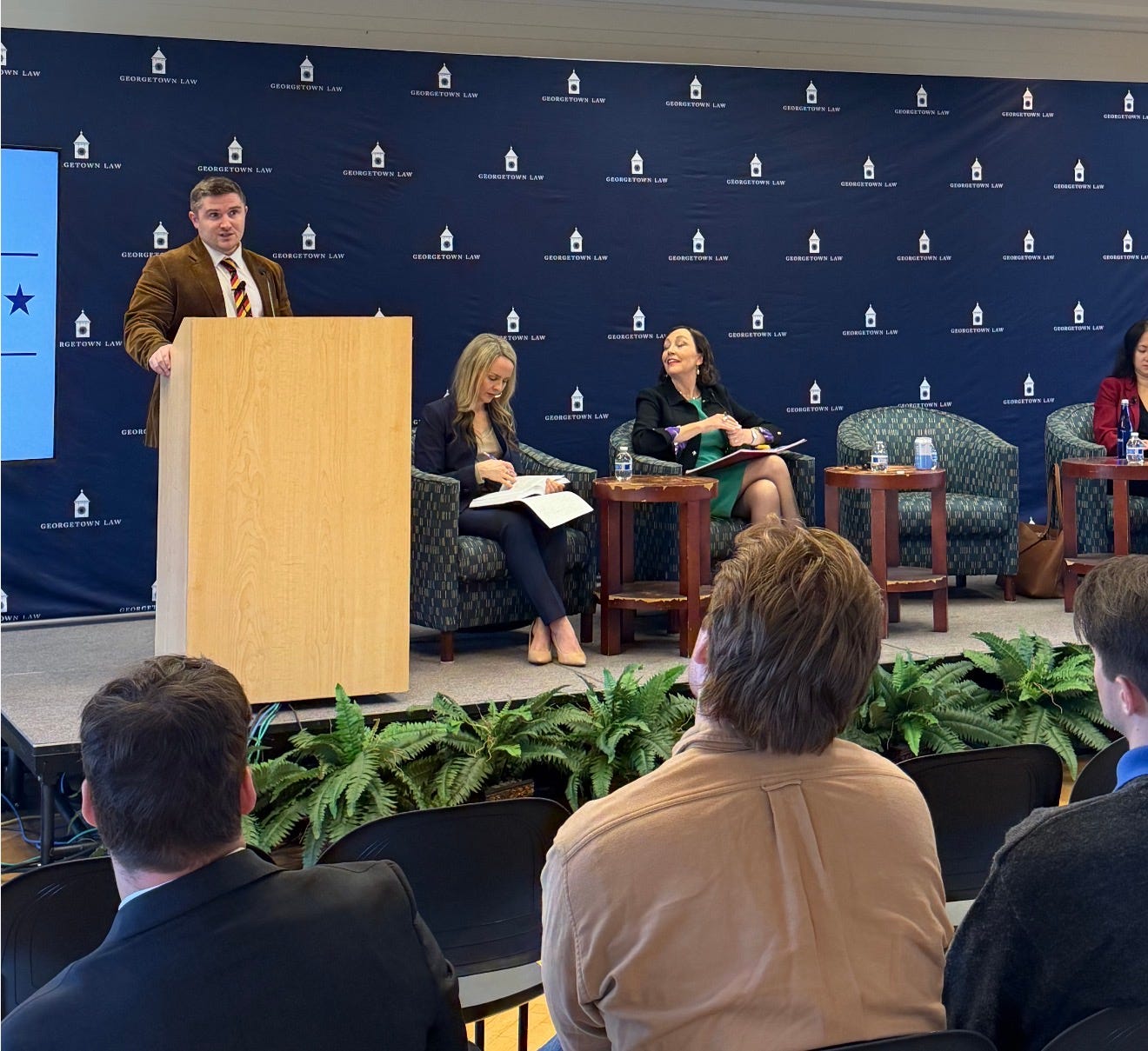
The following is a lightly edited copy of comments delivered at a symposium at the Georgetown Centre for the Constitution on the 18th March. The symposium was on Professor Aileen Kavanagh of Trinity College Dublin’s book The Collaborative Constitution (Cambridge University Press, 2024).
I. Digging into Constitutional Foundations
As I reread Aileen’s new book with a view to articulating why I thought it would have both contemporary influence and staying power in constitutional scholarship, my mind kept returning to a poem written by the Northern Irish poet Seamus Heaney, a poem called “Digging”.
Born in the town of Bellaghy, not far from where I grew up, Heaney spent his childhood in a very rural part of the country in a modestly prosperous farming family. His father was a farmer, as was his grandfather, with farming being the familal way of life stretching back generations. Heaney, however, was encouraged by his father to pursue the academic route, ending up at a Grammar school and then at Queen’s University Belfast studying English literature.
His poetry, for which he won a Noble Prize, was steeped in the sights, sounds, scenes, landscapes, folkways, and history of rural Northern Ireland. In his 1966 poem “Digging” – one of his earliest and most famous works, Heaney imagines writing in his room back in his family home and hearing his father digging in the garden below his bedroom window. He hears “a clean rasping sound…When the spade sinks into gravelly ground”
And he then thinks back twenty years to his childhood, where in his mind’s eye he sees his father:
“Stooping in rhythm through potato drills
Where he was digging.
The coarse boot nestled on the lug, the shaft
Against the inside knee was levered firmly.
He rooted out tall tops, buried the bright edge deep
To scatter new potatoes that we picked,
Loving their cool hardness in our hands.”
He thinks “By God, the old man could handle a spade. Just like his old man.” Heaney’s grandfather, he says “cut more turf in a day Than any other man on Toner’s bog.”
While admiring of his father and grandfather, he concludes by saying:
“But I’ve no spade to follow men like them.
Between my finger and my thumb
The squat pen rests.
I’ll dig with it.”
Heaney’s grandfather dug for turf (which is like wooden kind of coal taken from boglands) to provide fuel for the farmhouse hearth to keep his family safe, warm, and healthy; Heaney’s father dug for potatoes to provide the food to sustain and nourish his family; and Heaney himself chose the intellectual life and used his pen to “dig” deeply into the sights, sounds, scenes, landscapes, songs, folktales, and history of his homeland to sketch beautiful poetry showing us how, in the words of his Nobel Prize citation, the “local can articulate the universal… God is in the bits and pieces of the Everyday.”
In each case the everyday activity of digging, whether physically with a spade or intellectually with a pen, was the banal but necessary prelude to providing things of extraordinary value to human flourishing – warmth, comfort, food, nourishment, art, and beauty.
And I thought to myself as I read The Collaborative Constitution: Aileen, too, is a digger.
Aileen’s book is nominally about how different constitutional actors do – and ought to - come together to collaborate to protect rights, but many of her insights are relevant to much wider issues central to constitutional studies. Wielding her pen, she has dug deep into the everyday practices, norms, behaviours, and commitments of government officials of well-functioning constitutional systems like the UK – those which are generally stable and peaceful, robust in their capacity to respond to internal and external political challenges and lacking in sustained or systemic abuses of power. The book is best read as the product of intellectual digging into the discourses and practices of public law in well-functioning constitutional systems, and as an examination of what makes the formal constitution of texts, structures, and offices work.
Aileen probes the actions and mindsets of politicians, civil servants, government lawyers, judges, and parliamentarians who work within governing institutions - and her digging has excavated insights about what it takes for constitutional government to be successfully sustained over time and despite the tensions, conflicts, and ill-tempered spats that can break out between different organs of state.
Analogously to Heaney’s poetry, I think Aileen’s scholarship shows us how the profound; namely, the considerable ethical and civilisational achievement involved in sustaining constitutional government and the great goods it yields for human wellbeing: like avoiding tyranny, securing stability and peaceful transfers of power, promoting vigorous but non-arbitrary governance, channelling democratic energy and hope in peaceful ordered ways, is often built upon the foundation of the seemingly ordinary and hum-drum.
Constitutional government is sustained, in large part, through the slow bore process of countless officials going to work every day across the different offices of state and keeping the constitutional show on the road, motivated by virtues of collaboration, mutual restraint, trust, moderation, and compromise. Some everyday scenes that Aileen highlights occur every day in a well-functioning constitutional system without much comment or fanfare include:
Executive’s choosing to structure their internal workings so that concern for legality is central not peripheral, so that its policies are constantly screened by government lawyers for their compliance with statute, constitutional principle, and judicial rulings; lawyers who are bound by ethical codes of integrity and professionalism as well as loyalty to the incumbent administration.
Executive’s choosing to draft their statutes through using a professional corps of drafters who ensure statutes are drafted consistent with rule of law values, like accessibility, prospectivity, intelligibility.
Legislature’s choosing to internally structure their procedures to permit the executive to govern and implement its electoral mandate but while also providing official recognition to the Opposition, and regular and standing channels of Executive accountability – from ministerial questions to a well-resourced committee system.
Courts which are funded, independent, and not cowed or bullied such that they can render justice without fear or favour.
Courts trying to faithfully give effect to the lawmakers reasoned choices, within constitutional bounds.
Courts showing deference in both administrative and constitutional law cases to the institutional capacities and democratic legitimacy of the executive and legislature.
For Aileen, a key goal of the book is persuading people that these scenes, which happen everyday without comment, are focal case examples of constitutional relationships, the kind to be promoted and sustained precisely because they nourish, and do not sap, the life force of the constitutional system.
A more enduring constitutional order, Aileen wagers, is likely to be the one where each branch will be slow to press their formal legal powers to the absolute hilt where doing so might erode the robustness of the overall system; where the institutional capacities and responsibilities of each branch are respected when decisions impacting their functions are being made by the others; where each branch is rendered what it needs by the others to adequately discharge its functions; where disagreements are expressed firmly but civilly and not in apocalyptic or martial terms; where keeping good working relations is at the heart of the project of constitutional governance, not institutional combat by branches with deeply competing ambitions; and where there is a deep expectation that a shared commitment to the constitutional rules of the game will take priority over securing one’s immediate political goals. Aileen’s digging aspires to make these banal but essential foundations of constitutional government “visible for all to see”.
Aileen’s work travels, perhaps unconsciously, in the vein of many great works in Western political thought that argue that a critical precondition of sustaining a healthy polity, is that its citizens and officials must have a shared disposition and continuing joint intention to work together to secure their shared common good over time, and in the face of internal and external challenges and threats. As Augustine famously wrote in the City of God, the res publica, or body politic, is at its core a gathering of people and families “bound together by a common agreement as to the objects of their love”.[1]
The more durable polity will be one with a shared willingness amongst officials and citizens to endure and share hardship and challenges and to resolve or live with disagreements, so that together they can better protect the common objects of their love - the good of this polity and happiness of this people, over time. When this shared disposition of fellowship substantially frays, to the point it risks disappearing, so too does the polity in any focal sense of that term, as a community bound together with the common goal of the flourishing and happiness of its members.
In deeply impoverished forms of political community, there will be no serious joint intention amongst a people, between ruler and ruled, and amongst the rulers, to secure the common good of each and all. What might follow in the wake of a breakdown in common fellowship and civic friendship is a form of political life ruled by enmity, hatred, fear, disgust, provocation, and friend/enemy distinctions.
When a political community breaks down in this way, it can be truly disastrous for its citizens and all those left to languish in whatever diluted form of political association emerges from the turmoil, with the worst cases being dictatorships ruled by violence and repression, failed states wracked by anarchy, the tyranny of the warlord, or tribal factions engulfed in civil war. What is common to these forms of polity is that they lack worthy common objects of love and are all deeply disordered with respect to the essential function of political life: to secure human flourishing.
Aileen rightly observes that a tell-tale sign that a shared sense of fellowship is being eroded in a political community is where the basic rules “of the constitutional game” are “cursorily or contemptuously cast aside” for partisan or private gain. Maintaining the spirit of collaborative constitutionalism, I think we can say, is an important (but definitely not the only) part of maintaining a shared sense of fellowship and commitment to the common good of our political community now and for our posterity.
Aileen argues that acting to uphold and keep steady the relationships that make constitutional government effective is an expression of the virtue of patria – of “patriotism” and a reasonable recognition that our constitution is, to quote Finnis, “one of the fine things – our patrimony and social capital – to which it is good to be attached, in large measure because one is grateful that these things were made to be, and are there for us all in our infancy, maturity and, we hope, in any later dependency”.[2] Or as Aileen similarly puts it, commitment to making constitutional relationships work recognizes that our constitution is a “valuable inheritance from times past and a precious legacy for future generations.” To degrade or disregard a tried and tested constitution for one’s own private or factional ends is to indulge in the vices of ingratitude and injustice.
I think Aileen’s work will have its most lasting impact in reminding its readers about the importance of digging into the unwritten customs, dispositions, practices, and virtues like that of patria - that supply the muscle and sinew to the bones of formal constitutional structure and help that structure act for worthy common objects of love like the common good and its constitutive components of peace, order, stability, and civic friendship.
II. Digging into why executive power is important to good government
Another part of Aileen’s book I found compelling was her discussion of the executive as a pro-constitutional actor. Aileen takes aim at the trope of the “executive as evil – the constitutional villain of the piece which poses a standing threat to principles of constitutionalism, a presumptively problematic power which must be constantly cabined and contained”. The starting point Aileen adopts for assessing the proper place of the executive branch in a constitutional order is not to assume, as Endicott puts it, that there is “something generally wrong with constitutional executive power.”
Indeed, along with the likes of Aristotle, Aquinas, Alexander Hamilton, Max Weber, Elena Kagan, and Adrian Vermeule, Aileen associates the executive with a great many institutional goods important to a healthy body politic – its ability to act with energy, dispatch, technocratic expertise, and to serve as a focal point for electoral hope and expectation. Her point, which I think ought to be uncontroversial, is that it’s important to remember the rather obvious and banal fact that the executive plays the indispensable role as the directive and driving force of the State, the “engine” and “primary branch” of government, as Aileen puts it. More than any other branch, it shoulders the “awesome task of running the country”. And just one of many functions it shoulders is that of enforcing and protecting important rights and goods.
Of course, the executive can abuse its power and trample on rights. A prudent constitution will bind the executive to law and, in doing so, attempts to curb the risk of tyranny. But these risks, and our concern for abuses of public power, should not obscure the fact that the executive is essential for the protection of rights. The protection of human rights does not, in the last analysis, require either a domestic or an international court to engage in the judicial review of legislation. These are optional. But the protection of rights does require a body with the capacity to ensure that people are rendered what they are owed as a matter of justice.
It is often overlooked, by those who think rights find their primary protection in a specially designated charter and judicial review, that a great portion of ordinary legislation on our statute book exists precisely to protect human rights and goods. This legislation is, of course, drafted by the executive, initiated into the legislature by the executive, and enforced by the executive through the coercive, financial, and pedagogical powers of State.
Concern for justice and human flourishing is reflected in countless detailed statutes initiated by the Executive and enacted by Parliament. Think of statutes in our own countries which provide for things like access to healthcare and medicine; tiers of publicly funded education; social welfare safeguards for the elderly, ill, and those seeking work; housing assistance for the homeless or those on low wages; protection from arbitrary eviction; legislation and policies establishing labour rights and mandatory workplace protections; and countless others. These all concern the protection of human goods and well-being – the demands of justice, in other words. Indeed, even the criminal law code enforced by executive officials – the paradigmatic example of executive power – is in part about protecting and vindicating the basic rights of citizens to life, bodily integrity, and property. As Aileen puts it, the Executive is the branch that delivers rights to people with “concrete particularity”.
I think it is not an exaggeration to say that ordinary law drafted, initiated, and enforced by the Executive is how rights and human flourishing are primarily protected by the State in well-functioning polities. This is but one of many reasons why Aileen is undoubtedly correct to say the Executive is a branch of government “worthy of our cautious and careful respect”.
To dig a little deeper into the Executive’s importance, I think it is worth dwelling on at least one obvious risk of trying to maintain a weak executive. But while I think they are banal and obvious points, they might nonetheless be overlooked by those primed only to see the risks of executive strength.
Without a robust executive, constitutional systems risk descent into what the famous Italian classical jurist Bartolus dubbed “monstrous government.” This is a constitutional order where political authority is imbecilic, and unable to robustly use public power on behalf of the State to promote the good of citizens. Instead, there will be weak constitutional actors and several powerful ‘private’ tyrants - in the classical sense of seeking public power and influence for personal gain - all vying for control over the direction of the polity, but where none can assert a decisive balance of power.
Vermeule has argued that the “core evil” of this type of regime is its “incoherence” and “political chaos” due to its lack of “purposive rule of any kind”. It is rightly described as monstrous because the body politic resembles a hydra, each of whose several heads move independently and often in conflict with the others. A lamentable result of this political chaos and a serious lack of purposive rule for the common good is that it is conducive to immense proliferations in abuse of private power; abuse of the weak many by the powerful few, with the many lacking any access to countervailing public power.
A medieval analogue might be a kingdom with a weak monarchy, who is ill-equipped to prevent an oligarchical and greedy nobility from oppressing or exploiting the peasantry, or engaging in destructive internecine conflict. An example from the Gilded Age might be a government unable to prevent the predation of robber barons upon economically vulnerable employees and consumers. A more contemporary example would be a form of constitutional government whose executive, through an excess of veto points or sclerosis in taking effective political action, is unable or unwilling to protect the citizenry from the machinations of extremely wealthy and influential corporations, who have no particular concern for human flourishing – but whose decisions can carry enormous economic, environmental, and political repercussions for the community.
For those concerned about these risks, the movement within many constitutional systems to executive-centred government is explainable, and justified, as an accumulation of small-c constitutional changes and developments – countless delegations of statutory authority and a decisive shift in where citizen’s political expectations and hope lie – designed to sustain political authority better able to face down and contest with any “competing, partly extra-legal, and badly ordered” hierarchies, comprised of political actors and socio-economic elites led by private interests and not concern for the common good.
In other words, another prudential reason for the different branches of the State to collaboratively construct and maintain the executive-led administrative state, is that it can provide a standing institutional bulwark against the monstrous hydra identified by Bartolus emerging in the first place, or a remedy capable of slaying it.
The notion that a powerful executive can provide an institutional means of protecting the many from exploitation by the oligarchic few, is not a new or novel thought, but one present across centuries of public law thinking in the Western tradition in some form or another. Aileen, I think, is attuned to this - today often overlooked - classical way of conceiving of executive power.
III. Question
I will end with a question for Aileen; one I think may unearth some respectful disagreement. I would like to know how Aileen thinks her framework accommodates deeply reasoned and distinctively non-knee-jerk arguments for radical constitutional change that impact the extant powers of a branch of government.
The collaborative constitution is, at its core, about making the constitutional arrangements one already has work. This of course might include absorbing incremental and organic change - new conventions and norms might develop as constitutional actors interact to deal with new problems or revisit how they address old ones with fresh eyes.
But how does a framework focused on making the current constitutional arrangement work speak to situations where officials in some branches are convinced that the status quo needs serious, even radical, revision for deeply morally serious reasons linked to a concern for the common good – the same end collaborative constitutionalism is geared to promoting.
The specific example I’ll give is that, in the last decade or so in the UK, an increasingly large range of politicians, commentators, scholars, media voices, and citizens, have come to the firm conviction that the UK’s framework of human rights law anchored on the European Convention on Human Rights and Human Rights Act 1998, is inimical to the common good.
Now, many of these same people who would accept that, inasmuch as the Human Rights Act 1998 remains the law of the land, then the role of the courts in interpreting and enforcing it should be addressed with comity and respect. Judgments should be obeyed, government lawyers must advise on the law as it is, and the government should not invite the legislature willy-nilly to legislate contrary to its legal commitments.
But many have nonetheless come to the settled conclusion that the particular form of judicial power in the Human Rights Act 1998 is constitutionally intolerable for this polity, and they wish to see an executive with an electoral mandate invite Parliament to excise it and return, in crude terms, to the constitutional arrangements prior to 1998. What does the framework of collaborative constitutionalism have to say about these situations: where you have a distinctly non-knee-jerk, but settled and reasoned conclusion by many relevant constitutional actors, that a constitutional rebalancing is required.
Does this necessarily show a lack of comity? Are constitutional powers enjoyed by courts or executives settled for all time in aspic? Or can they be revised in a licit manner under the lights of the Collaborative Constitution?
[1] Augustine, City of God, XIX, chapter 24.
[2] John Finnis, “Reflections and Responses” in Robert P George & John Keown, Reason, Morality, and Law (Oxford University Press, 2013) 562.
 | A guest post by
|
Apologies, but when a post like this one is authored by “Managing Editors,” is it possible to determine who actually wrote it? I may be missing something. Thanks.
Good article, but the justification of the text made it borderline unreadable, at least on the mobile app. Please return to the previous format, this one is not a viable alternative.